Holiday Stress Survival Guide
Stress and the holidays seem to go hand in hand. What if, this year, we could master managing holiday burnout in a holistic and practical way? Time’s short, so let’s get right to it!
Maintain (or start) foundational daily habits like 30 mins of exercise, whole food based nutrition, avoiding processed junk food and sugary drinks, getting 8 hours of sleep, drinking plenty of water, limiting alcohol, and taking time for gratitude. Many of these habits are supported by research for improving mood and stress resilience but your mileage may vary.
Having a positive outlook actually helps us be healthier, but it takes practice. Think of your brain as a forest and you’re an explorer blazing a trail to a peaceful oasis of chill. You have to fight through tall weeds and low hanging branches at first, but every day you walk the path, you make it clearer than the day before. repeated thought patterns can contribute to reinforcing either positive or negative mental habits, a process supported by research on neuroplasticity.
If you only see the bad in everything and repeat things like “I’m so stressed!” and “nothing goes my way!” it may start to ring true for you. But if you look for the good in every situation, every person, every bad thing that happens, you start to take control of your thoughts and cope better. You can list the people and things you love, you can say things like “I can do this!” and “Today will be great, even if it’s not perfect.”
Download Our Holiday Stress Survival Guide
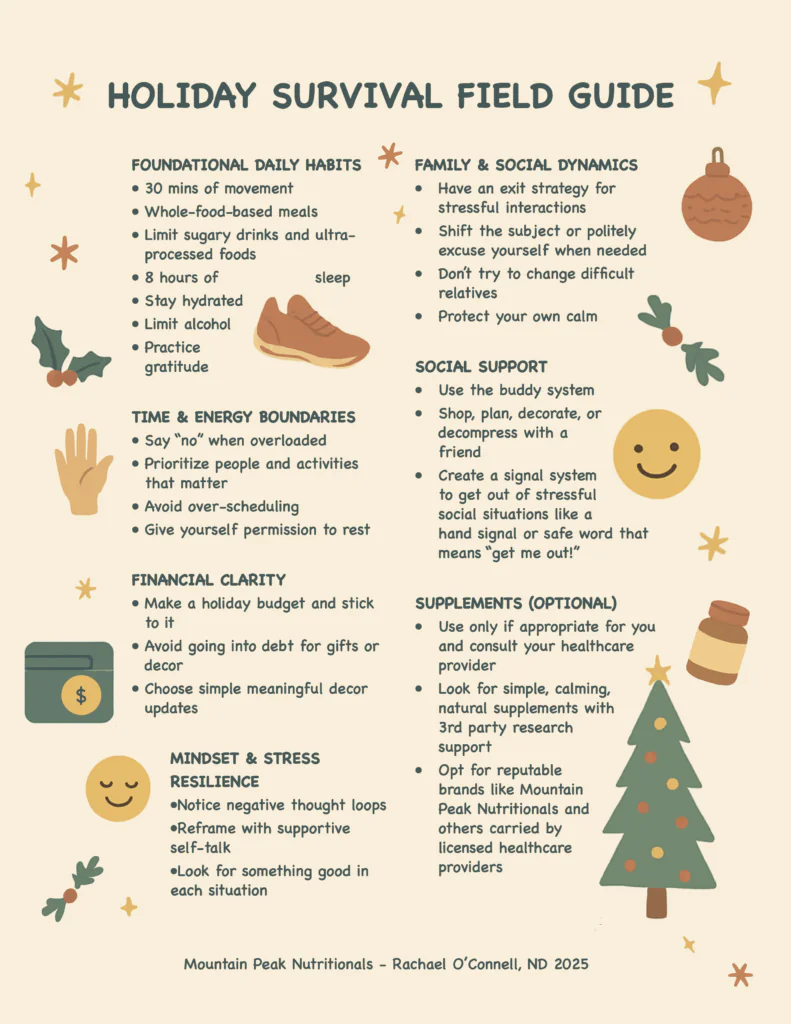 Time is such a precious resource, so learn to say “no” when you don’t have room for all the parties, gatherings, potlucks, or whatever else. Prioritize your loved ones and figure out what you actually want to do, rather than what you’re expected to do. You don’t have to prove yourself to anyone. You do have to live with yourself though, and being burnt out from over-socializing can be a real drag.
Dealing with family can be like diffusing a bomb sometimes, but there are strategies to keep your cool when things get weird. If someone has differing views, a low opinion of you, or they say inappropriate things, it’s okay, just let them be weird and find your exit. Let them look silly, while you keep your cool. Smile and nod, change the subject, fake having to pee and scamper off, or just say, “interesting, do you know what time the parade starts?” Weird family won’t change, so don’t try to change them; just roll with it. Don’t let them have power over you, your calm, or your blood pressure!
Note that all strategies work for everyone, and if family stress significantly impacts your mental health, seeking support from a professional is encouraged.
Money stress hits hard during the holidays, especially if we don’t budget well. Do you remember what your cousin, your aunt, or even your brother got you last year? Me neither. Don’t worry about being the benevolent gifting fairy, making sure everyone you know gets the most thoughtful, not-to-expensive, but not-cheap, but also personalized, most memorable gift in the world. Save your money and write them a nice card if you want. Make (and stick to) a budget that works for you and your family (and avoid financing). Most people in the USA are deep in debt, so just remember, the holidays emphasize love, togetherness, and gratitude; not who got the best gifts.
Speaking of money, holiday decorations don’t need to be unique or TikTok-trending every year. It’s a waste of money, time, and resources to overhaul your holiday decor every single year! One fun way to update without taking out a second mortgage is to just get a single new ornament every year. In my family, we look for something funny, cool, nostalgic, or strange to add to the tree and we don’t spend more than a few bucks!
Finding time to yourself while you’ve got the ghost of Christmas past rattling around the basement makes stress relief more difficult. We all need to make time to relax, not just when we crash hard into the pillow at 1am after wrapping gifts or getting all the prep for dinner done. Schedule decompression time for yourself. Set an alarm on your phone/watch. Follow it. When the alarm goes off, set a timer for 15 mins, go into a quiet, comfortable place nearby, and quietly breathe: inhale 4 counts through your nose, hold 4 counts, exhale 8 counts through your mouth. You can rub your temples, stretch, lie on your back with your feet up. Anything that calms you physically and mentally.
Decompressing is easier said than done, so investing in a calming nutritional supplement can really help. Mountain Peak Nutritionals has developed natural stress and sleep supports, like Tranquility Formula. Some people find it helpful in the moment or as part of a daily routine during stressful seasons. The usual dose is 1-2 caps, once or twice daily, as needed for stress relief. It includes several well-researched ingredients for their potential roles in supporting mood support including Taurine, Theanine, 5-HTP, GABA, vitamins, minerals, and calming herbs like Rhodiola and Magnolia. Tranquility is formulated to support a sense of calm and help maintain focus during occasional stress.
Be sure to talk to your healthcare provider before starting any supplement, especially if you take medications or are managing health conditions. Effects may vary widely by individual. This product is not intended to diagnose, treat, cure, or prevent any disease.
For all of these strategies, the buddy system is one of the best ways to implement them. Recruit close friends who can commit to managing holiday stress with you! Keep each other accountable and uplifted by making a budget together, tackling shopping as a team, helping each other decorate and wrap, and teaming up on your exit strategies for gatherings (like having a word, phrase, or hand signal that actually means “get me out of here!”).
At the end of the day, the world will continue to turn, even if you’re not perfect for the holidays. So rest in that and let the rest go. You got this.
Download Our Holiday Stress Survival Guide
Resources:
- Physical activity & stress/mood: WHO Physical Activity Guidelines: https://www.who.int/news-room/fact-sheets/detail/physical-activity
- Sleep and mental health: CDC Sleep & Health: https://www.cdc.gov/sleep/about_sleep/sleep_hygiene.html
- Sugar-sweetened beverages & health: Harvard T.H. Chan – Sugar and Health: https://www.hsph.harvard.edu/nutritionsource/healthy-drinks/
- Whole-food–based diet & well-being: USDA Dietary Guidelines: https://www.dietaryguidelines.gov
- Gratitude practices & psychological well-being: Greater Good Science Center (UC Berkeley) – Gratitude: https://ggsc.berkeley.edu/topic/gratitude/
- Neuroplasticity & cognitive patterns: Harvard Medical School – Neuroplasticity: https://www.health.harvard.edu/mind-and-mood/what-is-neuroplasticity
- Slow breathing & stress reduction: Cleveland Clinic – Deep Breathing for Stress: https://health.clevelandclinic.org/deep-breathing-exercises
- Managing holiday or financial stress: American Psychological Association – Holiday Stress: https://www.apa.org/topics/stress/holiday
- Alcohol & mental health: National Institute on Alcohol Abuse and Alcoholism: https://www.niaaa.nih.gov/alcohols-effects-health
- Nutrition evidence quality (how to evaluate health claims): FDA Guidance on Evidence-Based Review of Health Claims: https://www.fda.gov/regulatory-information/search-fda-guidance-documents/guidance-industry-evidence-based-review-system-scientific-evaluation-health-claims